M.I.A. | History Section | Philippines | Lineages and Schisms
Schisms and Lineages in the Philippine Left
Written:
History Archive for Philippine Socialism; K.M.Mongaya,
T. Giongco, Simoun Magsalin;
Published:
Marxists Internet Archive, May 2026;
Copyleft:
Creative Commons
(Attribute & Share-alike), Marxists Internet
Archive, May 2026.
You are free to display this
work under the terms of the CC license.
Note
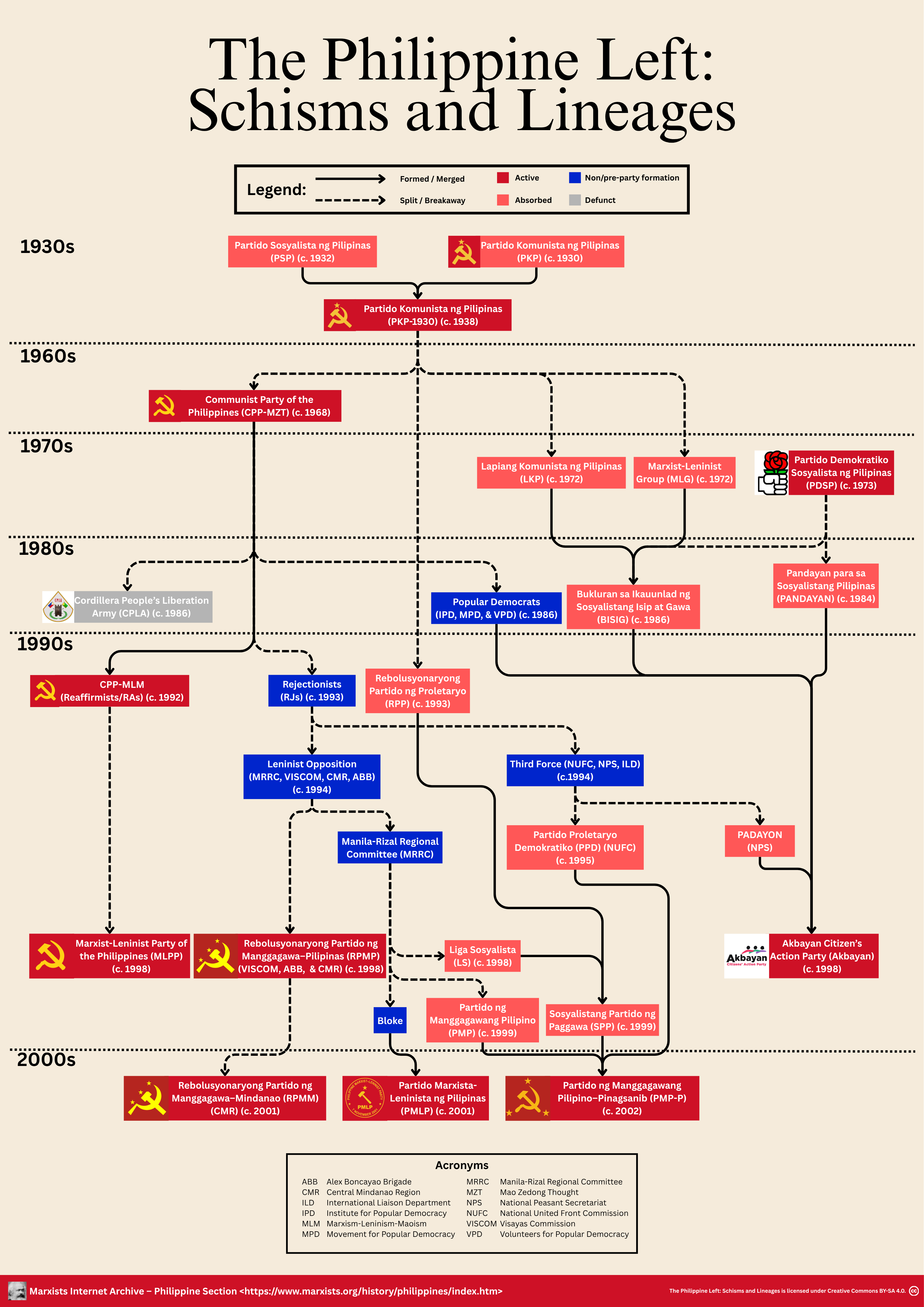
“The Philippine Left: Schisms and Lineages” diagram is a chronological flowchart that maps the organizational history, ideological schisms, and organizational development of the Philippine communist and radical tradition from the 1930s to the early 2000s. The diagram shows, decade by decade, how the country’s major radical leftist political organizations formed, merged, split, and changed over time. In making this visualization, we adhered to a time embargo that ends the timeline in the early 2000s to avoid inadvertently harming or mischaracterizing ongoing realignments within the Philippine radical left over the last 25 years.
By the appellation “radical,” we refer specifically to groups and movement organizations seeking anti-systemic change; in other words, those aiming to fundamentally challenge or overturn prevailing political, social, and economic structures. “Major” parties are defined as those groups that have demonstrated sustained national organization, formal structures, and significant influence or impact on the development of the radical left over multiple decades. “Pre-party formations” and “selected non-party formations” included are those with direct lineage links to these major parties or that fulfilled pivotal roles in significant schisms or realignments. Some of these formations are former Party organs of earlier parties. Others are affinities of former cadres that did not bring an intact Party organ but still carried over substantial political traditions, forms of struggle, and cadre cultures. Such lineage can be established when groups bring in cadres from earlier traditions, carrying over identifiable ways of thinking, debates, and some continuity in their political positions. The diagram thus covers organizations that, though not strictly anti-systemic, have played key roles as stepping stones or gathering points for more radical currents. Smaller NGOs, mass organizations, and transient political coalitions are excluded to preserve focus and clarity.
Finally, the organizations identified were selected through a careful review of scholarly literature, historical records, and conversations with key informants familiar with developments in the country’s radical left.
Selected Bibliography
Caouette, D. 2004. Persevering Revolutionaries: Armed Struggle in the 21st Century, Exploring the Revolution of the Communist Party of the Philippines. Dissertation, Cornell University
Mongaya, K.M. 2025. “La izquierda radical filipina: legados históricos, desafíos contemporáneos.” Espai-Marx. <espai-marx.net/?p=18164>.
Reid, B. 2000. Philippine Left: Political Crisis and Social Change. Manila: Journal of Contemporary Asia Publishers.
Santos, S., and P.V. Santos. 2010. Primed and Purposeful: Armed Groups and Human Security in the Philippines. Quezon City: South-South Network for Non-State Armed Group Engagement.
Citation
History Archive for Philippine Socialism. 2025. “The Philippine Left: Schisms and Lineages.” Diagram, Marxists Internet Archive (MIA). <www.marxists.org/history/philippines/explainers/lineage.htm>